







Lynside® Prebiotic Yeast
The gut microbiome has a significant impact on one’s health and overall well-being, and scientists are just now beginning to understand all its complexities. Peer-reviewed research has shown that the microbiome can be modulated with many distinct types of prebiotics. A shared property of most prebiotics is that they stimulate the same bacteria species. Lynside® Prebiotic Yeast, manufactured by Gnosis by Lesaffre, modulates the gut microbiota diversity to support gut health and promote a healthy microbiome.
Highlights
- Lynside® Prebiotic Yeast is the first prebiotic yeast on the immunity market.
- Lynside® Prebiotic Yeast consists of yeast cell walls gently extracted from Saccharomyces cerevisiae yeast cells.
- It has a composition of about 25% β-1,3/1,6 glucans fibers, and 25% mannans.
- It is the first yeast prebiotic that can improve the diversity of the microbiome with a low gas production.
- The prebiotic effect is shown through the metabolic activity of the gut microbiota, contributing to energy production by increasing production of Short Chain Fatty Acids (SCFAs).
- The recommended daily dosage is lower than conventional prebiotics.
Microbiota vs. microbiome
Sometimes used interchangeably, these two terms have subtle differences. The microbiome refers to the collection of genomes from all the microorganisms in the environment. Microbiota refers only to all the microorganisms native to an ecosystem. A healthy microbiome and its microbiota profile support beneficial microorganisms, and maintain a balanced immune system, which underscores good health.
Though everyone’s gut microbiome has a distinct signature, it shares a fundamental structure that is similar between all of us. The gut microbiome can be divided into different enterotypes. Each enterotypes has its own gut microbiome composition. These enterotypes are strongly associated with different regions and are affected by one’s lifestyle and food habits, while factors like stress can also affect digestion.
Dietary components may help or hinder the development of certain microorganisms, and they also contribute to the overall composition of one’s gut microbial genetic pool. This may be accomplished via a change of diet (rich in plant carbohydrates and fibers from fruits, vegetables, whole grains, and grains) but also using food supplementation, alongside fermented foods. In that sense, there are two major components that may play a role in the microbial diversity of the gut: probiotics and prebiotics.
The role of prebiotics on the microbiome and gut health
The official definition of a prebiotic is “a selectively fermented ingredient that results in specific changes in the composition and/or activity of the gastrointestinal microbiota, thus conferring benefit(s) upon host health” (1). To summarize, prebiotics are mostly carbohydrate substrates that feed some beneficial bacteria, allowing them to thrive and replicate more effectively.
The main gut bacterial phyla are Firmicutes, Bacteroidetes, Actinobacteria, Proteobacteria, Fusobacteria, and Verrucomicrobia. Ninety percent of the gut microbiota are made up of Firmicutes and Bacteroidetes. Those microbes interact with both the epithelial cells lining the gut and cells of the immune system, helping regulate inflammatory responses while supporting gut function and immune response (2).
In the past decade, prebiotics have become an important way to support gut homeostasis (balancing gut health) and the immune system and deliver a measurable health benefit. Inulin, Fructooligosaccharides (FOS), and Galactooligosaccharides (GOS) have been the most investigated prebiotics to date. These three prebiotics, however, mainly stimulate the same bacteria species. Therefore, relying solely on two or three prebiotics may be limiting when there are 100 to 400 bacteria species and many distinct strains inhabiting one’s gut microbiota.
Why diversity matters for gut microbiome balance
Any ecosystem like the gut’s community of microbes, must always be kept in a delicate equilibrium state. When the gut microbiome is out of balance (dysbiosis), this often results in problems with digestion. Inflammatory bowel disease, obesity, allergies, and neurodegenerative diseases have all been associated with this type of imbalance. An important function of the gut microbiome is the barrier effect that helps beneficial gut microbes prevent invasion by a variety of mechanisms, but most importantly, by impacting immune homeostasis (3).
Research suggests that having a wide array of microbes in the gut makes for a healthy gut microbiome that is capable and resilient (4). A diverse microbiome may work more effectively than a microbiome with only a few representatives of these species, because if one microbe is unable to perform its function, another potentially pathogenic one may take over.
The more, the merrier, as a diverse microbiome is a resilient microbiome! The best diet for supporting a healthy gut microbiome is ideally a plant-based diet centered on fruits, vegetables, and whole grains. Eating these foods can support nutrient absorption and overall well-being. Adding prebiotics, such as yeast supplements, will also encourage proliferation of beneficial bacteria for a healthy microbiome.
Lynside® Prebiotic Yeast: The game-changer for microbiome diversity
Lynside® Prebiotic Yeast, manufactured by Gnosis by Lesaffre, is the first patented prebiotic yeast and is positioned for use in dietary supplement applications, with proven effects supported by in-vitro studies.
Lynside® Prebiotic Yeast is made through the gentle extraction of yeast cell walls from Saccharomyces cerevisiae, rather than baker’s yeast used for leavening. This extraction includes a specific carbohydrate composition of fibers and is a valuable source of mannans and β-1,3/1,6 glucans. All of which have important prebiotic effects on beneficial bacteria.
In-vitro studies have shown that Lynside® Prebiotic Yeast may help support a healthy balance of microbiota for different enterotypes. The prebiotic effect may be exerted through enhancement of the metabolic activity of the gut microbiota by increasing SCFA production, which also supports energy production. Lynside® Prebiotic Yeast is not intended to treat disease and should be used with guidance from a healthcare provider when needed.
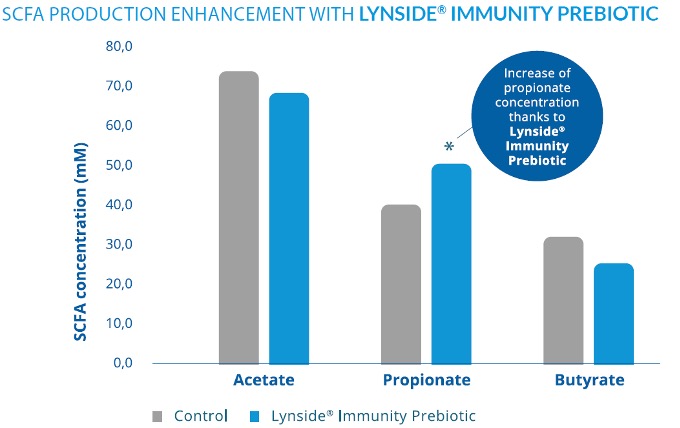
Furthermore, the pattern of SCFA production appears to be dependent on the gut microbiome composition. Due to its complex carbohydrate composition, Lynside® Prebiotic Yeast can be metabolized either by one bacteria group or another and induce the production of specific SCFAs. The enhancement of butyrate and propionate production occurred in a dose-dependent manner of two different microbiota patterns representative of the healthy general population.
The gut microbiota’s ability to make SCFAs is well documented in scientific literature and might be connected to:
- Improvement of the gut barrier function.
- Direct impact in the mucosal immune cell population and immune modulation linked to inflammatory responses.
- Potential impacts on other organs in the body.
Preliminary data confirms these immune-stimulatory effects, suggesting Lynside® Prebiotic Yeast can be a valuable prebiotic for supporting immunity. Further research is still needed to confirm this improvement of the immune response.
The positive impact of Lynside® Prebiotic Yeast on microbiota diversity is, however, highlighted in vitro. Its effectiveness has been tested and shown in several in-house studies, and recently, using an ultramodern dynamic model of gut microbiota simulator, namely the PolyFermS® (Polyfermentor Intestinal Model). This is an effective technique for studying mechanisms of the gut microbiome without using a living host (5).
Thanks to its proven prebiotic effects, Lynside® Prebiotic Yeast has the potential to revolutionize immune health supplements.
References:
1) Gibson G.R. et al., Nature Reviews. in Gastroenterology and Hepatology. 2017.
2) Rinninella E. et al. What is the Healthy Gut Microbiota Composition? A Changing Ecosystem across Age, Environment, Diet, and Diseases. Microorganisms. 2019.
3) ILSI Europe Concise Monograph Series. Probiotics, Prebiotics and the gut microbiota. 2013.
4) Dogra SK et al. Gut Microbiota Resilience: Definition, Link to Health and Strategies for Intervention. Front Microbiol 2020; 11:572921
5) Poeker S.A. et al. Understanding the probiotic potential of different dietary fibers using an in vitro continuous adult fermentation model (PolyFermS®). Scientific reports. 2018
Discover the Lynside® portfolio
All Lynside® products come from yeast and support gut health, immunity, daily nutrition, and overall well-being by delivering key nutrients, including vitamins, minerals, and B vitamins.
The Lynside® range is composed of Saccharomyces cerevisiae, spanning probiotic yeast, prebiotic yeast, and nutritional yeast for plant-based health solutions.